Sunday, April 11, 2010

The end


Isn't this image beautiful? I love the clots of color, and the graceful pale shapes in the center. I find it a soothing image, even though I know what it is: a micrograph of brain tissue damaged by rabies.

When I arrived at the trailhead this morning I saw an adult raccoon curled up on the ground in the middle of a clearing. Not a good sign. Nothing wild ever settles down for a nap on a lawn. The raccoon was lying perfectly still and I assumed it was dead, but I resisted the urge to get a closer look to make sure. Rabies is always a concern here, and that's a natural phenomenon I'd just as soon not learn about firsthand.

As I started down the trail I saw a ranger's truck pulling up next to the clearing. A couple of minutes later I heard a shot behind me. I guess the ranger didn't want to take any chances either. When I came back down the trail there was no sign at all of ranger or raccoon.

Who knows what was wrong with the raccoon--it may have just crawled out there to die after being hit by a car. Whatever the cause, it's sad to think of it struggling, instinct lost, helpless under the open sky.


Image from Wikimedia Commons.

Sunday, April 4, 2010

In the presence of animals


After posting that beautiful Levertov poem, I went walking in the woods Easter morning and encountered some less spiritual wildlife. It was clear and sunny, and couple of days of warm weather have the redbuds blooming. A cardinal was singing his heart out somewhere. I was just thinking how perfectly beautiful it was when I heard a scrabbling sound followed by ferocious snarling. I looked around for the source and discovered it about 10 feet up the trunk of a tree. It took me a second to figure out that I was looking at the rear end of a weasel, pushing his way into a cavity that looked much too small for him. Judging from the contortions of the weasel, his snarling, and the pitiful cries coming from inside the tree, I'd say he was making breakfast out of a chipmunk, or possibly a nesting squirrel. Whatever it was it put up a pretty good fight, but the weasel won. He somehow got his whole bulk into the tree and shortly thereafter the cries stopped. He growled a bit more and then fell silent, too. Busy eating, I assume.

The rest of my hike was serene. As I approached the lake two great blue herons took off toward the rising sun, casting their shadows behind them. A pair of Canada geese flew low over the water in the opposite direction, murmuring to each other in that perfect harmony they have. I came upon a flicker and a pileated woodpecker that were perched on adjoining tree stumps, apparently enjoying each other's company until the woodpecker answered her calling mate and left to join him on the other side of the lake.

Weasel with chaffinch, Bruno Liljefors, 1888

Sunday, March 28, 2010

Housekeeping


What Blogger really needs is a dead link alert, so bad housekeepers like me don't have to discover by accident that they're sending folks on a snipe hunt. I just discovered that my link to "Sign-Post" above has been sending readers to a blank page at the Poetry Foundation. Dang. I love that poem. If you were disappointed by the old link, try this one. Hope it lasts a while.


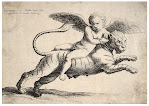
La Récureuse, André Bouys, 1737

Unsettled


I frightened a duck this morning. She was tucked up in the weeds at the edge of the lake and I never saw her before she let out a squawk and scuttered out onto the water, wings spread, feet slapping the surface. She got 20 feet from the shore and instantly settled down, paddling serenely as if she had completely forgotten fleeing for her life 2 seconds before.

The weather is wonderfully unsettled here--storms and heavy rain last night, fitful rays of sun after dawn, then the descent of a pregnant black cloud as I hiked around the perimeter of the lake. Sunlight leaked around the cloud’s edges as it dropped fat drops of rain. The wind rose up and spread sheets of silver over the water. It carried a red-tailed hawk’s call to me from the opposite shore. The bird was perched in the crook of a tall tree, hollering in hope or anger. He took off and flew in wide circles over the lake, defying the rain, which promptly stopped.


Photos of Red-tailed Hawk courtship


The scent of spring, after the rain, Ma Lin (Song Dynasty), 13th century

Sunday, February 14, 2010

Tracking


It’s not terribly cold here, but it’s gloomy and there’s been snow on the ground for days. I haven’t had much company on my hikes. On Thursday morning I listened to a long concert from a pair of coyotes who were very riled up about something, and Saturday morning a great blue heron flew over the lake. I’ve heard a woodpecker or two knocking around the woods. That’s about it. The rest of the birds are mostly silent and even the squirrels are scarce. I’d think all the critters were hibernating, waiting for winter to end, but the snow tells me otherwise. There are lots of dainty deer prints going from the tree line down to the lake. The turkeys leave scribbled evidence of their chronic confusion as they wander in circles among the trees. The feet of skunks and rabbits mark the trails for short distances before their owners think better of it and veer off toward safe cover. Raccoons don’t travel along the trails much at all, but they clearly go out of their way to use the footbridges—raccoons hate wet feet, apparently. Coyotes rarely leave tracks on the bridges, although they like to walk the trails for long distances. So do bobcats. I followed a bobcat track for at least half a mile yesterday. The cat had traipsed right along the trail, as if on a hike of its own. Walking beside the line of footprints, I felt I had a ghost companion, a feline familiar. As we came to a place where the trail crossed a road, the bobcat’s track abruptly turned away, back into the woods. I paused for a moment to say goodbye and then headed on my way.


Photo of mouse tracks in the snow from the National Park Service via Wikimedia Commons

Sunday, January 31, 2010

"...stretched out upon Mother Earth"


I’ve spent a good portion of my Sunday reading The Book by Alan Watts—the sort of philosophical meringue that seems delightful as you consume it but leaves you hungry for something more substantial. Watts walks the thin line between expressing ideas simply and reducing them to something simple-minded. The Book’s considerable wisdom shares the page with a certain amount of 60s-style spiritual claptrap, which is kinda fun but doesn’t help me take the whole enterprise seriously. I thought about giving up on it a couple of times today, but I hung in there and was rewarded with Watts' quote of this passage from Schrödinger’s My View of the World:

“Thus you can throw yourself flat on the ground, stretched out upon Mother Earth, with the certain conviction that you are one with her and she with you. You are as firmly established, as invulnerable as she, indeed a thousand times firmer and more invulnerable. As surely as she will engulf you tomorrow, so surely will she bring you forth anew to new striving and suffering. And not merely ‘some day’: now, today, every day she is bringing you forth, not once but thousands upon thousands of time, just as every day she engulfs you a thousand times over. For eternally and always there is only now, one and the same now; the present is the only thing that has no end.”

Alrighty then. That was worth wading through 100 pages of The Book to reach. I’ve seen the last sentence of that quote before, but never the bit that precedes it. Schrödinger expresses in a few elegant words the joyful intuition that lures me into the woods. I can grasp that sense of being continually brought forth only when I literally throw myself on Mother Earth. This blog is all about dancing around Schrödinger’s insight, seeking the eternal now of union and metamorphosis.


The Carrot, Willem Frederik van Royen, 1699

Monday, January 11, 2010

"One must have a mind of winter"


Yesterday we woke up to an Arctic freeze, and today we're back to an ordinary Tennessee chill. When you live where the winters are mild it's easy to forget the special beauty that bitter cold creates. An ice-blue sky, glittering snow, the perfect silence that falls when it's so cold that no animals stir--these are rare pleasures for us.

The Snow Man

by Wallace Stevens

One must have a mind of winter
To regard the frost and the boughs
Of the pine-trees crusted with snow;

And have been cold a long time
To behold the junipers shagged with ice,
The spruces rough in the distant glitter

Of the January sun; and not to think
Of any misery in the sound of the wind,
In the sound of a few leaves,

Which is the sound of the land
Full of the same wind
That is blowing in the same bare place

For the listener, who listens in the snow,
And, nothing himself, beholds
Nothing that is not there and the nothing that is.


Text from Poets.org
Jay Keyser analyzes the poem here.

Garden under Snow, Paul Gauguin, 1879